Home
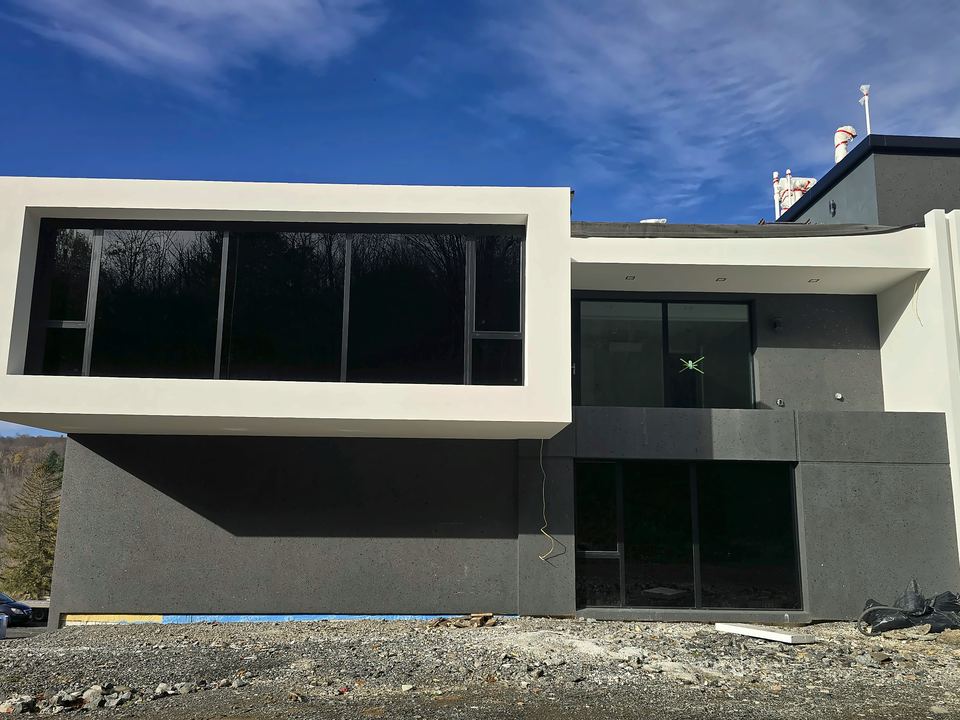
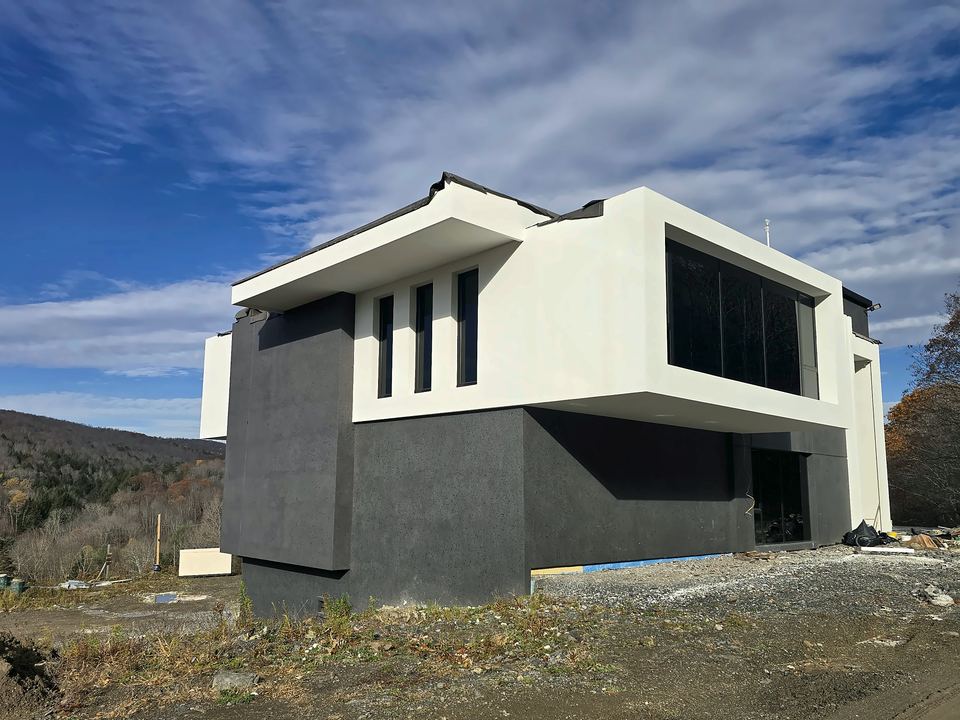
New EIFS on a steel-framed house, Catskills
A new EIFS envelope over 8 inches of continuous insulation, in a white finish and a dark gray textured finish.
Guide · winter in the Capital Region
We reply within one business day, Monday to Friday.
Updated October 2026
Short answer
Finish work mostly waits for spring. EIFS base coats and finishes, and cement stucco, need about 40 °F and rising, with no freezing for 24 hours, and Capital Region winters rarely allow that. In winter we can make temporary weather-tight repairs, look at walls and write estimates, so the permanent repair is ready to go when the weather turns.
Key facts
Because the materials need time above freezing to set. Acrylic finishes dry as their water evaporates, and cold slows that to a crawl; cement-based base coats and stucco need to hydrate, and water that freezes in fresh plaster breaks it apart. That is where the working rule comes from: about 40 °F and rising, with no freezing for 24 hours after the material goes on. Wet weather matters as much as cold. Rain, frost or snow on a fresh finish can wash it out or leave marks that stay.
More than most people expect, just not the finish:
The table below sorts the common jobs by season.
A short-term fix that keeps water out until the permanent repair can be made. Depending on the wall, that might mean closing an open crack or a woodpecker hole, covering a damaged area, or keeping water away from a roof-to-wall corner until the flashing can be corrected. It isn't meant to look finished, and we tell you what is temporary. The permanent repair, with matched finish, follows when the temperature allows. See EIFS repair and stucco repair for what that repair involves.
Not if water can get into it. Over a Capital Region winter, water in a crack freezes, expands and opens it further, and behind EIFS the water can reach the sheathing. A hairline crack in the middle of a sound wall can usually wait. A crack at a window corner, below a roof line or with a stain under it is worth a look now and, if needed, a temporary repair. Stains under a roof edge are often a missing kick-out: here is how roof-to-wall leaks are fixed.
Elevation by elevation, on the days the temperature allows. On a new house in the Catskills, mountain weather limited the days for base coat and finish, so the finish coats were scheduled one elevation at a time, and the EIFS envelope was completed in fall 2025. Late-season jobs in the Capital Region follow the same rule: no finish goes on when the 24 hours ahead are forecast to drop below freezing. A spring recoat is easiest to book while the calendar is still open.
| Job | Winter (below about 40 °F) | Spring through late fall |
|---|---|---|
| Site visit and written estimate | Yes | Yes |
| Finding a leak and a temporary weather-tight repair | Yes | Yes |
| EIFS base coat, mesh and finish | Only inside a heated enclosure | Yes, at about 40 °F and rising |
| Cement stucco coats | Only inside a heated enclosure | Yes, with no freezing for 24 hours |
| Sealant replacement | Limited by the sealant's temperature range | Yes |
| Recoating and painting | No | Yes, in dry weather |
| Kick-out and flashing repairs | Temporary measures; the wall around the flashing waits for warmer days | Yes, with the wall rebuilt and refinished |
A new EIFS envelope over 8 inches of continuous insulation, in a white finish and a dark gray textured finish.
Permanent finish work usually can't. EIFS base coats and finishes, and cement stucco, need about 40 °F and rising, with no freezing for 24 hours, and Capital Region winters rarely give that. Below it, work needs a heated enclosure, which adds cost. In winter we can make temporary weather-tight repairs and come back for the finish in spring.
Roughly spring through late fall, when days and nights stay above freezing and the 24-hour window above 40 °F is reliable. Late spring and early fall are often easiest, with mild temperatures and less hard sun on fresh finishes. Very hot days bring their own limits, so summer work is planned around shade and the time of day.
It can. Tenting a wall and heating the space holds the temperature the materials need, but it adds the cost of the enclosure, the heat and the extra time to set it up. It is usually saved for commercial schedules that can't wait. For most homes, a temporary repair now and the permanent repair in spring is the better value.
Yes. Site visits and written estimates don't depend on the temperature, and getting the scope done in winter means the repair can be scheduled as soon as the weather turns. It is also a good time to look at walls: stains, ice and wet spots show where water is getting in, and leaves are off the trees, so walls are easier to see.
What we repair and how, once the weather allows.
Cracks, chimneys and parging on cement stucco.
The leak to deal with before the snow melts.
One even color for a faded wall, planned over the winter.
Rather text?
(518) 888-7851Text 3–5 photos of the problem area: one close-up and one of the whole wall.
Or upload photos with the form. Upload photos
Book spring work now. Winter assessments and estimates available.
Text a few photos of the wall and we'll tell you what can be done before spring and what should wait.